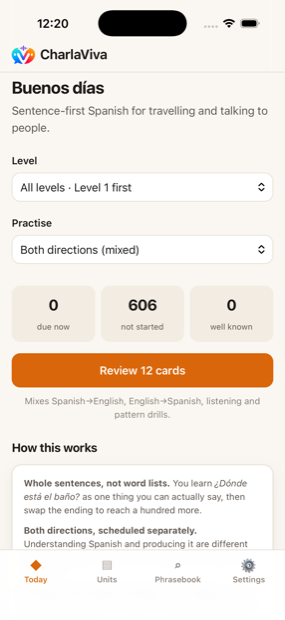
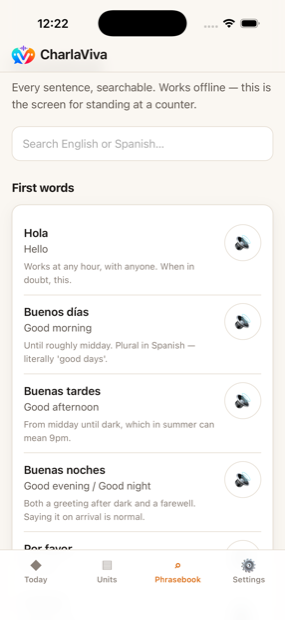
CharlaViva teaches travel and social Spanish one whole sentence at a time, brings it back just before you'd forget it, and keeps working when your signal doesn't.
Four decisions separate CharlaViva from a phrasebook with a timer attached.
You learn ¿Dónde está el baño? as one thing you can say, with its grammar and politeness attached. Word lists produce people who know 500 words and still can't order a coffee.
Recognising la cuenta and producing it are different skills that fade at different speeds. Most apps merge them, so the easy direction hides the hard one — you feel fluent until you have to speak.
A memorised phrase gets you one situation. ¿Dónde está …? with a swappable ending gets you a hundred. Pattern drills sit in the main queue, because optional practice gets skipped.
Each card returns at the moment it's about to slip. That's the whole trick, and it's why five minutes a day beats an hour on Sunday.
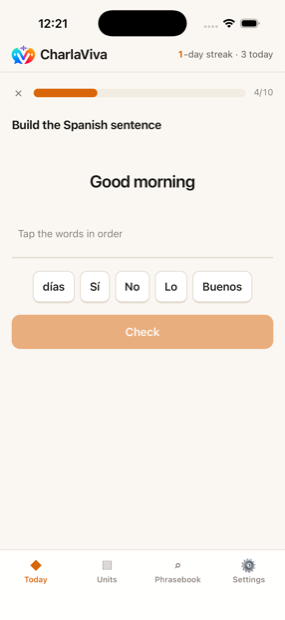
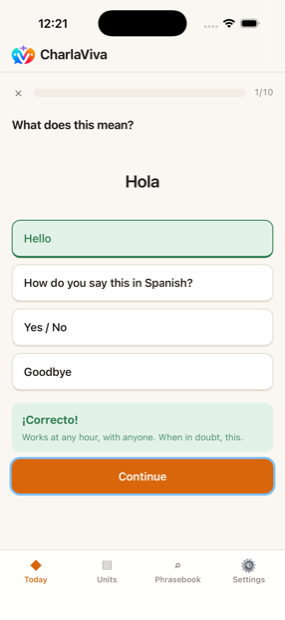
Five exercise types, a progress bar and instant feedback. You never grade yourself — the app reads your answer and schedules the next review from it.
Assemble the Spanish word by word. Production practice without fighting a phone keyboard, and the distractor tiles are real words from the same situation.
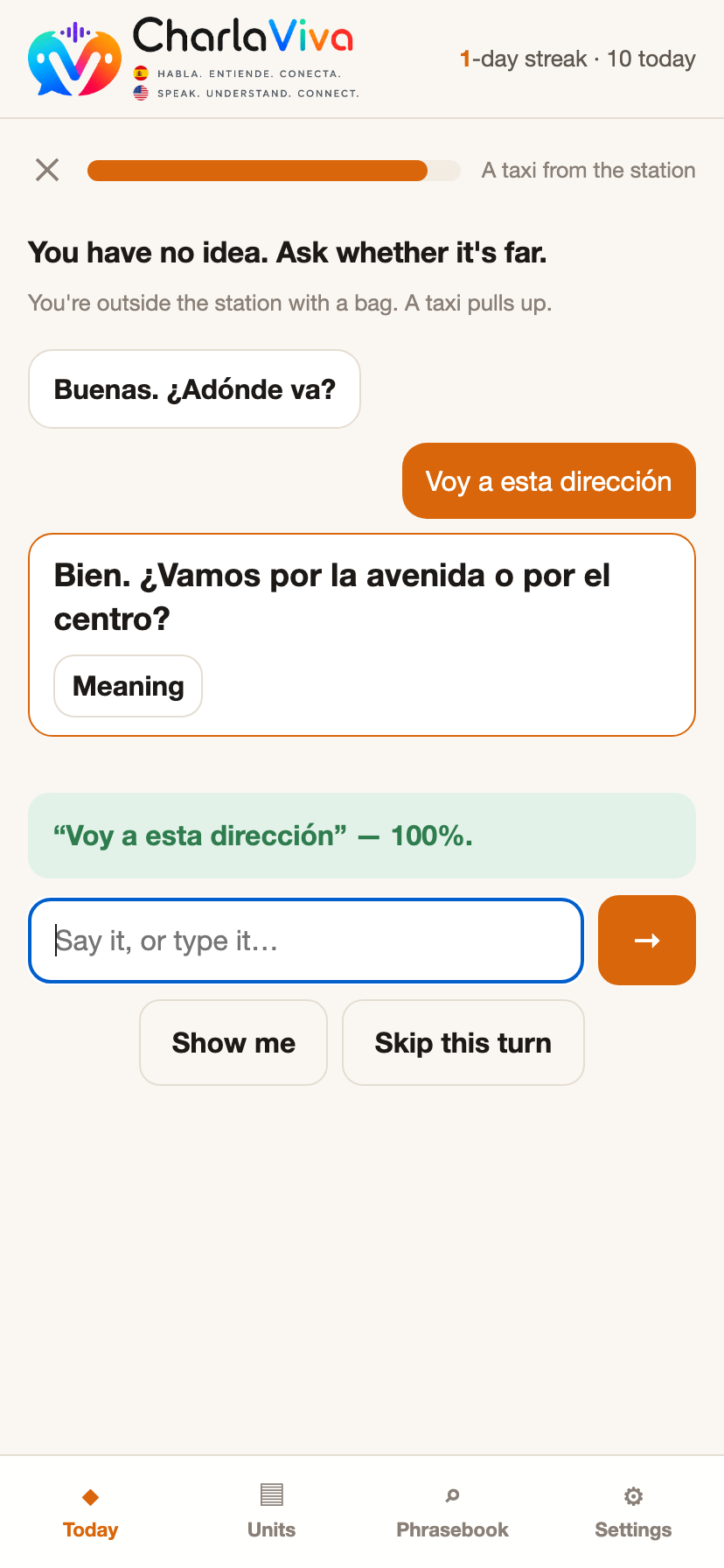
Speak the sentence and get told how close you were — including which word you dropped. Two attempts before it moves on.
Listening exercises with no text to lean on. Understanding speech at speed is the thing travellers are worst at.
Complete a frame like ¿Dónde está …? — the exercise that turns one memorised phrase into a hundred sentences you can build.
Enough momentum to make it a habit — and deliberately no hearts and no leagues. Hearts punish the extra practice you want to be doing, and leagues would need a server, which would end working offline.
Underneath, every answer feeds a real spaced-repetition schedule. Getting a sentence right unaided counts for more than picking it from four options, and the next review is timed accordingly.
Every sentence is spoken aloud, with a slow replay for the ones that run together. On production cards you can tap the microphone, say the phrase, and get told how close you were — including which word you dropped. Spanish is close to phonetic, so hearing while reading teaches pronunciation almost for free.
Every sentence, searchable, offline. For the moments when you don't want to revise — you want the words, now.
Cards carry what a phrasebook leaves out: when perdón is wrong and con permiso is right, why me gusta works backwards, that la carta is the menu but el menú is the set lunch. Latin American Spanish by default, with the Spain variants shown where they matter at the counter.
Open it in a browser and add it to your home screen — that's the whole install. It runs from the same code as the iOS and Android builds, so nothing is a second-class version.